Open House — No. 01
The architects, artists and films that shaped my eye
By Amitta Sathitsamphan — Studio Balançoire
2 October 2026
Come in, come in. Mind the boxes, I haven't finished tidying. That is rather the point of an open house, isn't it? A door left ajar, a bit of a mess, and the feeling that you could stay for tea.
This is my very first journal entry, so forgive me if I wander. I am an interior designer at heart, and I want to talk about architecture and rooms the way I would talk to a friend, which is to say honestly and slightly out of order. Interiors can be whimsical, you know. Playful, a little odd, terribly personal. And they become so much simpler when we stop chasing trends and follow who we are. A room that is truly you can never go out of fashion, since it never cared about fashion to begin with.
Still, I do believe in having heroes. Admiring someone is not copying them, it is teaching your eye to wake up. So for this first Open House, I am opening the door on the people I love and why they have never left me.
Architects and artists
Almost everyone on this list is gone now. All we have of them is what they left behind: the houses, the paintings, the rooms we can still walk into. But I have always felt that was only half the story.
I am curiously nosy, I admit it. I want to know who they were. How they talked, how they lived and worked, what they were like when nobody was looking.
A building keeps a little of its maker inside it, and I think that by getting to know the maker we learn to trust our own instincts. As an artist, being yourself matters more than anything. Many of them left letters, interviews or memoirs, and I fully intend to read every one.
In alphabetical order, because I need some order somewhere:
Albert Frey
Simplicity, nature, possibility.
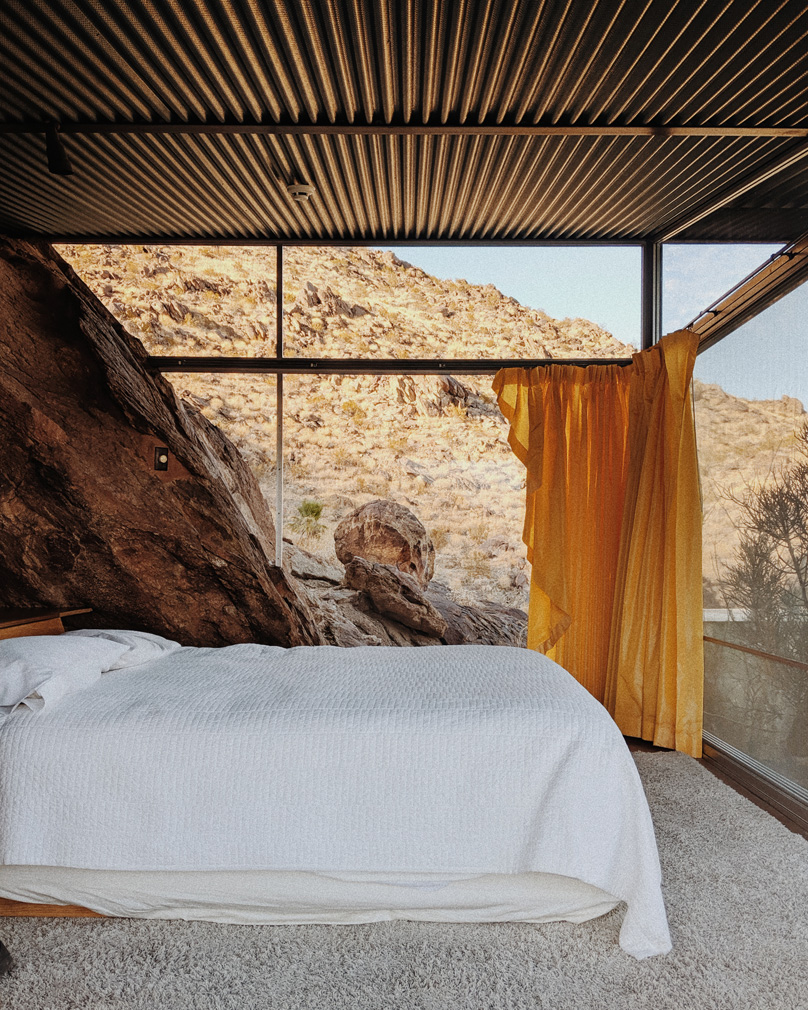
He built himself a little house in the desert and curled it around a boulder rather than moving it. Isn't that wonderful? He did not try to boss the landscape, he listened to it. I think a good room does the same with whoever lives in it.
Egon Schiele
The stroke.
Intense, restless, fearless, and gone at 28, which still breaks my heart a little. Gustav Klimt spotted his talent early and encouraged him, but where Klimt decorated and gilded, Schiele stripped it all away and kept only the line. When I look at his drawings I feel someone who could not hold anything back.
Frank Lloyd Wright
Nature and wholeness.
He thought a building should grow out of its place, so he built Fallingwater directly over a waterfall instead of politely facing it. Famously sure of himself, he designed the interiors too, furniture and lamps and all, as if a house were one single thought.
I rather envy that kind of certainty.
Gaetano Pesce
Rebellion, color, imperfection.
He poured resin into furniture and embraced variation rather than perfect repetition, because imperfection is part of what makes an object feel alive. I spent a semester in Italy studying interior design, and I like to think some of his mischief rubbed off on me.
Georgia O'Keeffe
Color, stroke, form.
She left the city for the New Mexico desert and made it hers without asking anyone's permission. I admire that quiet independence, and I count it as a design choice too: deciding where and how you will live before anyone tells you what is in fashion.
Gio Ponti
Lightness and elegance.
He founded Domus, built a skyscraper in Milan and designed the Superleggera, a chair weighing barely 1.7 kilos. He never separated the building from the teaspoon, which is more or less my whole note on names.
Joan Miró
Play and youth.
You would imagine a messy, spontaneous man, yet he worked with extraordinary discipline. So much lightness, built with so much rigor. He gives me permission to be playful in a room, and to take my playfulness seriously.
Le Corbusier
The inventor, opinionated and never satisfied.
He changed how the world thought about modern living. And yet he spent his summers in a tiny wooden cabin by the sea, which tells me that even the man who designed for the masses knew how little a person truly needs.
Luis Barragán
Color.
He spoke of silence, solitude and serenity, and believed a home should be a refuge from the noise of the world. His pink walls and golden light are not decoration, they are feeling built into architecture.
He trained in engineering rather than following a conventional architecture-school path, and perhaps that is part of why his work can feel so elemental: a plain wall, a window, and then he lets light and color do the rest.
Ricardo Bofill
Drama and dreams.
The Catalan architect built red fortresses on the Spanish coast and monumental housing that looks like a stage set, and chose to live and work in an old cement factory that he transformed into his own strange castle.
I love that he saw poetry in something so abandoned. Whatever he touched, he made theatrical.
Tadao Ando
Concrete, light, silence.
He never went to architecture school. A boxer in his youth, he taught himself through travel, observation and study, and then built with almost nothing: raw concrete, pure shapes and light.
He is the one on this list who is still building today, thankfully.
Xavier Corberó
Structure and form.
The Catalan sculptor created spaces that feel carved rather than built, ancient and modern in the same breath. He is the one I discovered while he was still alive.
I watched his interviews, and what struck me was how light he was. I saw a child in him, and I am quite sure that is exactly where his work comes from.
Interiors in film
Films are the next closest thing to living inside an interior, with the advantage that the rooms are alive.
I do not need to say much. Sofia Coppola, David Lynch, Jim Jarmusch, Stanley Kubrick and Pedro Almodóvar all know that a room is a character, and I get to sit inside their rooms for two hours.
And then there is Luca Guadagnino, a filmmaker who also works in interiors, which explains why his houses feel so deliciously lived in.
Then there are the architecture and interiors of the old James Bond films, the 1960s and 1970s ones. Villains' lairs carved into volcanoes, sunken living rooms, glass and concrete houses perched in the desert, all of it so confident and so gloriously over the top.
I will confess I watched them for the sets as much as for the man, and I would happily move into that volcano tomorrow.
When I want real homes on paper, I turn to two magazines I always come back to: Milk Decoration and Architectures à Vivre.
A small note on names
You may notice I have not listed a single interior designer. That is on purpose.
Many of the houses I admire were conceived as complete worlds: architecture, furniture, lighting and objects shaped by one vision, from the foundations to the teaspoons.
That idea of continuity has always stayed with me.
The door is still open. Now I would love to hear from you.
Besides yourself, who are your inspirations and role models, the people whose lives or work taught you to trust your own taste?
Share with me.
See you at the next Open House.